Earl Rich Composting Secrets
Launch promo ends in 00:00:00
Get the Composting Manual — $47 $27
Earl Rich Composting Secrets

The difference is not luck, and it is not a secret ingredient sold in a jar.

I have built piles that cooked to a hundred and sixty degrees in three days, and piles that sat there like a wet dog for a year and did nothing. The difference is four things: what you feed it, how big it is, how wet it is, and how much air gets into the middle. Ninety chapters on getting those four right — and on every way a backyard pile goes wrong.

Instant download · Yours forever
90
Chapters
7
Parts
137
Pages
Earl Rich

"I have not written one page here I would not stand behind at my own back fence."

Before You Begin
The Backyard Composting Manual — First Edition
I · The Manual

The Backyard Composting Manual

This is a working manual, not a book about saving the planet.

Every method in here has a real materials list, a real amount of time attached to it, and a real result you can dig your hands into. Some of it comes from the videos on the channel. Most of it goes further than the videos ever do, because a video has to end and a compost pile does not.

I want to be honest about the promise on the cover. Finished soil in half the time is not marketing. A pile built the way most people build it — a bucket of scraps thrown on a heap once a week — takes a year or more. A pile built the way this book describes is finished in a season, and a hot one built on a Saturday afternoon is done a great deal faster than that.

"A compost pile is not a container where things rot. It is a feeding operation. Everything a pile does that looks like magic is a side effect of that eating."

Where a method costs money, I say what it costs. Where it does not work, I say so. And every chapter ends with a section called The Limits, where I tell you the part most people leave out: what the method will not do, what goes wrong with it, and when it is the wrong tool for the job you are trying to do.

The chapters are short on purpose. You should be able to read one with your coffee and go out and do it that same morning.

Get the Composting Manual — $47 $27
II · The Difference

Nobody fails at composting for want of a special ingredient. They fail on one of four dials.

Ninety-five percent of compost problems answer to one of four questions, and the fix is almost always free. Here is what changes once you know which dial you are turning.

How most backyard piles go
  • A bucket of scraps thrown on a heap once a week, for a year
  • A bin the size of a laundry basket that never heats, and nobody knows why
  • Grass clippings alone, matted into a slimy green layer that smells like a barn
  • A tumbler bought on the promise of compost in fourteen days
  • An activator out of a jar, bought to fix a pile that was simply too dry
  • Guessing at moisture, then watering a pile that was already drowning
  • Digging it out at six months, still full of recognisable orange peel
  • Flies, rats, and a conversation with the neighbour
  • Spread hot and half-done, and seedlings that stall in it
  • Free manure or straw brought in, and a vegetable bed that never recovers
How this manual has you build
  • Two to three parts browns to one part greens, by the bucket, no chemistry
  • Three feet in every direction — the dial half of all failed piles ignored
  • Grass layered rather than heaped, and the mat solved before it forms
  • The tumbler chapter that tells you what one is actually good for
  • The wrung-out sponge test: squeeze a handful, it gives up a drop or two
  • Read the pile first — a walkthrough that names the wrong dial in ninety seconds
  • Shredded and layered, with the temperature curve to expect from day one
  • Sited, covered and fed so rats, flies and raccoons have no reason to come
  • Cured — the phase everybody skips — then screened and tested three ways
  • The herbicide chapter, and the jar test you run before you trust free material
III · What's Inside

Ninety chapters, seven parts, in the order a pile actually happens

The rules, then the build, then what goes in, then the heat, then everything that goes wrong, then the other systems, then using what you made. Every chapter closes with The Limits.

Part One

The Ground Rules

Chapters 01–12 · 12 chapters
  • What is actually happening in a compost pile
  • The four dials: food, air, water, size
  • Browns and greens without the chemistry lesson
  • Why the pile has to be three feet wide
  • The wrung-out sponge test
  • Particle size: why shredding cuts months off
  • Hot piles versus cold piles: picking your speed
  • The seven myths that keep piles from working
Part Two

Building The Pile

Chapters 13–26 · 14 chapters
  • Where to put the pile, and what goes underneath it
  • Two bins or three: planning the flow
  • The free heap: building with nothing
  • The pallet bin: a Saturday build
  • The wire ring bin and the trash can composter
  • The tumbler: buying one and making it work
  • The in-ground pit and the buried bucket
  • The one-afternoon hot build
Part Three

What Goes In, What Stays Out

Chapters 27–47 · 21 chapters
  • Kitchen scraps: the everyday list
  • Coffee grounds, tea bags, eggshells, citrus, onions
  • Bread, rice and pasta — and cooked food, oil and grease
  • Fall leaves: the best free material you have
  • Grass clippings without the slime
  • Weeds, seed heads, and diseased plants
  • Manure: which animals, and how long
  • Herbicide contamination: the one that ruins gardens
Part Four

Heat, Time, And Speed

Chapters 48–58 · 11 chapters
  • The thermometer and what it tells you
  • The temperature curve from day one to day thirty
  • The turning schedule
  • The eighteen-day method
  • Activators: what works and what is sold
  • Getting a stalled pile hot again
  • Killing weed seeds and pathogens
  • Curing: the phase everybody skips
Part Five

When It Goes Wrong

Chapters 59–72 · 14 chapters
  • Reading your pile: a diagnostic walkthrough
  • It smells like ammonia — or like rotten eggs
  • It will not heat up at all
  • It heated once and then quit
  • It is too wet and slimy — or bone dry
  • Fruit flies, house flies, and grass mats
  • Rats, mice, raccoons, dogs and bears
  • White fuzz, mold, and strange growths
Part Six

The Other Systems

Chapters 73–84 · 12 chapters
  • Worm bins: setup for twenty dollars
  • Feeding worms, and worm bin troubles
  • Harvesting castings
  • Bokashi: fermenting instead of rotting
  • Trench and sheet composting, and leaf mold
  • Composting in an apartment
  • Hot climates, drought, and composting through winter
  • Compost tea: the honest version
Part Seven

Using What You Made

Chapters 85–90 · 6 chapters
  • How much to use, and when
  • Top dressing, side dressing, and mulching
  • Is it finished? Three tests
  • Making a potting mix and starting seeds
  • Storing compost without losing it
  • Giving it away, selling it, and scaling up
In Every Chapter

The Limits

Ninety of them
  • What the method will not do
  • What goes wrong with it, and how you will know
  • When it is the wrong tool for the job
  • Which numbers are the centre of a range, not a setting on a machine
  • What varies by climate, season, and material
  • Which earlier chapter this one leans on
And at the back — the reference pages
  • The Quick Reference card: ratio, moisture, size, temperature, turning, finish
  • Every temperature band and what it is telling you
  • A glossary of every term used, in plain English
  • Aerobic, anaerobic, C:N, castings, curing, leachate, leaf mold
  • Actinomycetes, mesophilic, thermophilic, aminopyralid, vermicompost
  • A Last Word — the page to read before your first pile
Get the Composting Manual — $47 $27
Instant download · Yours forever
IV · Reader Results

From the first readers

What people write in after their first season with the manual on the kitchen counter.

★★★★★

"Four years of a bin that never did a thing. Read Part One, rebuilt the heap three feet wide instead of two, and it hit a hundred and forty degrees in four days. It was the size the whole time."

Dennis W. · Ohio
★★★★★

"My pile stank and I had been adding more grass to fix it. Chapter 61 explained why that was making it worse. Turned it, forked in a bale of leaves, and the smell was gone by the weekend."

Marisol T. · Central Texas
★★★★★

"The Limits sections are why I would pay for it again. Everybody else tells you what to do. Earl tells you where it stops working, which turned out to be the part I needed."

Ray K. · Second season, Oregon
Earl Rich
V · About

A backyard. Not a farm, and not a municipal facility.

My name is Earl Rich, and I run Composting Secrets. I have been making compost in a backyard for a long time — not on acreage, not with a loader. A heap, a fork, and a fence line.

This book is for everybody who has ever hauled a bag of soil out of a store and set it down next to a trash can full of the same thing. That is most of us. The material is free, it is already on the property, and the only thing standing between it and a wheelbarrow of finished soil is knowing which of four dials to turn.

I am not going to tell you compost will save the world, and I am not going to pretend it is difficult. It is a biological process running at biological speed. You can feed it better, give it more air, and chop the food finer. What you cannot do is make a bacterium eat faster than a bacterium eats — and anything sold on the promise that it will is selling you a fifth dial that does not exist.

Some of what is in this manual has appeared in videos on the channel. Most of it goes further, because a video has to end and a compost pile does not.

Earl Rich
First Edition · 2026
VI · Order

The Backyard Composting Manual — First Edition

One file. Ninety chapters. Yours the moment you pay.

Launch Promo · First Edition

From kitchen scraps to finished soil in half the time

  • The complete 137-page illustrated PDF
  • 90 chapters across seven parts
  • The Limits section closing every chapter
  • Seven bin and system builds, with materials and real costs
  • The full diagnostic walkthrough for a pile that stinks, stalls, or will not heat
  • The Quick Reference card: ratio, moisture, size, temperature, turning, finish
  • A plain-English glossary of every term used
  • Reads on phone, tablet or laptop — and the reference pages print
$47 $27
Launch promo
Get the Composting Manual — $47 $27
Instant download · Yours forever
Secure checkout by Gumroad
Visa · Mastercard · Amex · PayPal
VII · Questions

Before you buy

Is this a real manual, or another book about saving the planet?

There is nothing in it about saving the planet. It is materials lists, bin builds, ratios, temperatures, and the specific order to do things in. Where a method costs money I say what it costs. Where it does not work I say so, and every chapter ends with The Limits, which is where I tell you what the method will not do. Treat every number in the book, mine included, as the centre of a range rather than a setting on a machine.

Your videos are free — why would I buy this?

A video has to end, and it has to be about one thing. The manual is all ninety chapters in the order a pile actually happens, with the reasoning underneath each one and The Limits at the foot of every chapter. The chapters also lean on each other, which a playlist cannot do: almost every problem in Part Five traces back to the browns-and-greens balance in Chapter 3 or the moisture test in Chapter 5, and the book points you back by number every time.

Why only $27?

Because the material this book is about is free and already in your yard, and it would be a strange thing to put an expensive book in front of it. $27 is the launch price against $47. It is less than two bags of the soil you are currently buying, and a great deal less than a season of paying somebody to haul away the leaves that would have made it.

What format is it, and how do I get it?

A single illustrated PDF, 137 pages, delivered by Gumroad the moment you pay. It opens on a phone, a tablet or a laptop, and the Quick Reference card and glossary are laid out as pages you can print and pin up in the shed. No app, no login to remember, no subscription.

My pile has never heated up. Does the book actually fix that?

It is the first thing it does. A pile that will not heat is not broken — it is a pile where the workforce cannot eat, and there are only four reasons for that: nothing worth eating, no water, no air, or too small a crowd to keep warm. Chapter 59 walks the diagnosis in order, and Chapters 62, 63 and 53 take the three commonest versions of it apart. The fix is almost always free.

I do not have room for a three-foot pile. Is this any use to me?

Yes. Part Six is the systems that need no heap at all: worm bins for about twenty dollars, bokashi, trench and sheet composting, leaf mold, and a chapter on composting in an apartment. Part Two also covers the small-footprint builds — the trash can composter, the wire ring, the in-ground pit, the buried bucket. What you give up in a small system is speed and heat, and the book is straight with you about that instead of pretending otherwise.

Does it cover the things that go wrong — smells, flies, rats?

Fourteen chapters of Part Five are nothing else. Ammonia, rotten eggs, too wet, bone dry, grass mats, fruit flies, rats and mice, raccoons, dogs and bears, white fuzz and strange growths, weeds sprouting in the pile and then in the beds. Each one starts from what the symptom is telling you about the dial that is off, because the smell is the diagnosis rather than the problem.

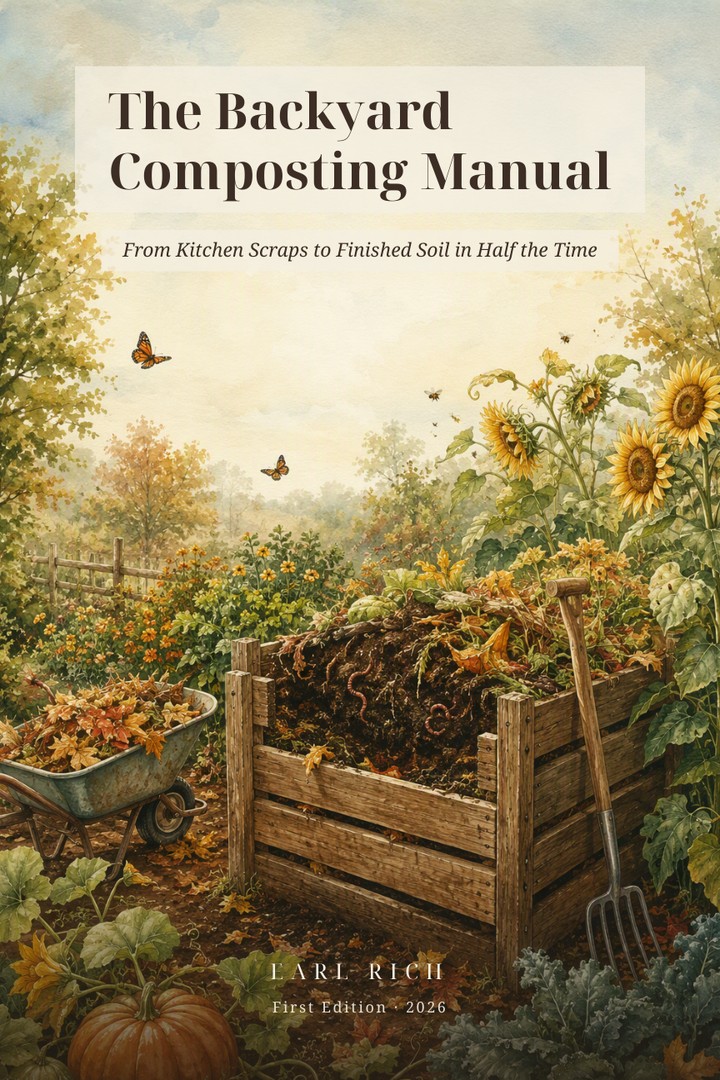
Get the Composting Manual — $47 $27
Instant download · Yours forever
The Backyard Composting Manual
Wait — one thing

Less than two bags of the soil you are already buying.

Ninety chapters on turning what is already in your yard into finished soil — $27 during launch instead of $47. The material is free. This is the book that tells you which four dials to turn.

Get the Composting Manual — $47 $27
Instant download · Yours forever
or see what's inside →